


It’s been a long time since we’ve talked about the Ibis Ripmo — but today we’ve got the pleasure of riding the new Ripmo V3. Few bikes have had the cult following of the Ripmo in the last five years — and for good reason, too. Not many bikes offer this blend of climbing ability and descending chops. Ibis has completely overhauled the V3 Ripmo with a new frame, new geometry, new suspension kinematics, and internal frame storage. So, is it still the top dog in the all-mountain category? Stick around to find out. Oh, and don’t worry — yes, I know the new Ripley launched today, too. We will get to that one in a couple of days, stay tuned.
Let’s briefly cover some of the high-level talking points before we go riding. Ibis said they built the new Ripmo based on customer feedback. They already had a great bike, but they addressed common talking points brought up by customers to make this year’s improvements.
First, this year’s Ripmo has just a tiny bit more travel, 150mm in the back and 160mm up front. With the launch of the HD6 last year, Ibis can now make the Ripmo a little more all-mountain than enduro. The build becomes more appropriate for a bike in its travel category with a Fox Float X and Fox 36 or Marzocchi Z1. The tires get slightly less aggressive as well. That helps bring the weight down a hair while also separating the options in their lineup.
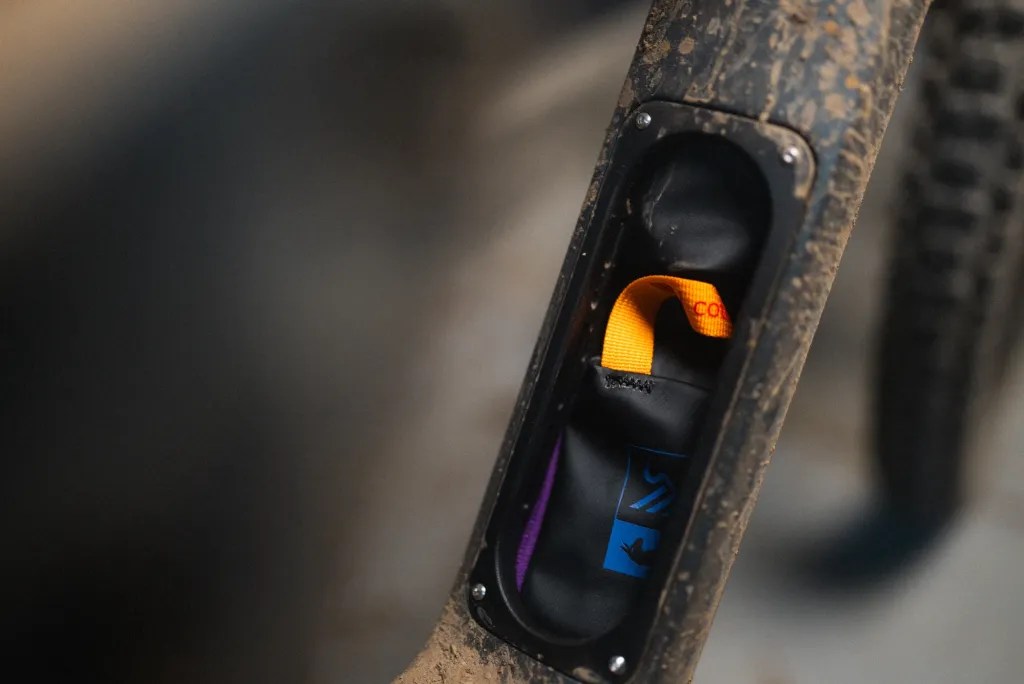
The Ripmo V3 now gets internal frame storage with some cool Cotopaxi collab bags. The frame also features a flip chip for 27.5” or 29” rear wheels. Sizes small and medium will come stock with an MX wheel setup, while extra-medium through extra-large will ship with two 29” wheels.
Let’s talk about sizes really quickly. Ibis has made five sizes in the new Ripmo. That should allow for a lot more overlap between sizes, letting you pick based on handling characteristics. I’m riding a large for now, which, to be honest, fits just like almost every other XL I’ve ridden recently. Pay attention to frame measurement, or go take one for a spin before you buy based on the size alone.



The frame comes with size-specific chainstays and suspension kinematics. And this one is a little interesting — I see the reasoning, but I’d prefer this update didn’t happen. Ibis has made size-specific BB heights to help with pedal strikes. Essentially, the bigger the frame, the higher the BB — we’re only talking a couple of millimeters here. The idea being with a longer wheelbase, you’re more likely to high center in the middle. I get it, pedal strikes suck, but I’m going to ruffle a few feathers here and say if you’re pedal striking frequently, it’s probably a you problem. Technique and timing go a long way in eliminating pedal strikes. Don’t pedal where you shouldn’t — I don’t want my BB and, subsequently, my center of gravity to be higher than necessary because some folks hit their pedals a lot. All that said, the higher BB is not noticeable enough to call attention to itself out on the trails. The Ripmo still corners very well and is stable enough for the category. But knowing it could be a few MM lower bugs me — at least on paper.
We also see an updated mini-clevis that allows for compatibility with all coil shocks as well as a more coil-friendly leverage ratio. Alright, let’s go ride.
Ibis Ripmo V3 Ride Review
Uphill
One of the best things about the Ripmo over the years has been how well it pedals, given its descending ability. I remember taking a spin on the V1 and being blown away by its climbing performance. And that’s a feature that hasn’t changed much over the years. The Ripmo V3 is still at the top of the category. I’m hard-pressed to think of a better climbing 150mm travel bike.
Let’s start with the geometry. I found the body position to be a little more forward-leaning. The reach is long, the seat tube is steep, and the front end is moderately low. All of which will pull/push your weight further toward the front of the bike. It’s not extreme, though — I wasn’t uncomfortable, and I’m pretty sensitive to low front ends because of the bad neck. This position is great for keeping control over the front wheel and keeping it down on steeper climbs. Especially with the slightly shorter rear center, the forward body position keeps you from falling off the back of the bike.
The suspension platform is very Ibis — it’s efficient and quick on the pedals. It’s great for long climbs, out-of-the-saddle efforts, and techy sections where you need to squeeze out every last drop from the bike. Unlike previous Ripmos, the V3 seems to get into the mid-stroke just a tad easier, though, giving you more control and traction in the bumps. The previous Ripmos tended to sit higher in the travel and feel firmer in bumpy terrain. This could be seen as a pro to some people, but I prefer the traction and control, even on the climbs — so I’m giving the nod to the V3 here.

Downhill
The Ripmo V3 is easily the most capable descending Ripmo to date. Yet it finds itself equally happy in rough terrain as well as cruisy, flowy terrain. It is one of the few bikes I’ve ridden lately that transitions so easily from rough to smooth or tight and technical to flat-out speed. It’s extremely versatile in that regard.
It’s interesting that the new Ripmo gets a slightly lighter-duty build than it had with the V2, yet it’s noticeably more willing to ride tough terrain and welcomes high speeds. Goes to show that geo and suspension design make a much bigger difference than the parts slapped on the frame. Either way, the Ripmo gets a significant capability upgrade over the previous versions. It did get a little slacker, but only by a few tenths of a degree, so I think the bulk of the stability and capability comes from the longer wheelbase. The V3, in size large, has an almost 20mm longer wheelbase than the V2 in XL. That’s apparent when you’re pushing the pace or find yourself in rough and bumpy terrain.
The new Ripmo’s suspension feels quite a bit easier to get along with than previous versions. It still has that active initial stroke like previous versions, but it seems easier to get the bike into the mid-stroke while not blowing through the end stroke too easily. It tends to hang up less and rolls through chatter better. I really can’t find any fault with it. Maybe I got lucky, but pretty much right out of the box, I stumbled on suspension settings that fit my riding style and trails perfectly. There’s enough sensitivity and traction for a bike in its category, enough travel and bottom-out support for riding the rougher stuff, and still enough mid-stroke support for jumping and changing lines. Ibis has knocked it out of the park on the suspension design.
It’s a bit funny, but I found myself feeling quite a bit more comfortable on rough terrain on the Ripmo than I did on the HD6. I think it largely comes down to the amount of traction the bigger 29” rear wheel offers. It seems a little crazy, but I think the extra few MM of rear center help, too. I also find it interesting that the wheelbases on the HD6 and the Ripmo (size 4 vs size large) are almost identical—the Ripmo is only 2mm shorter. I’ve come to find that for me and the trails I like to ride, which usually end up being higher speed and rough, wheelbase is one of the biggest factors in how comfortable I am on a bike. I’d be curious to do some back-to-back laps on the HD6 and Ripmo.
I’ve been spending a lot of time riding some rough and rugged trails on my Rocky Mountain Altitude this summer. I’ve made an effort to go ride all of those same trails on the Ripmo just to see how capable the bike is. I’ve found that the Ripmo is probably faster and more fun on most of them, minus the roughest and steepest ones. It’s easier to maintain speed on the Ripmo on the mellower grades and in the corners. It doesn’t feel like too much bike until you’re on the easiest of trails. It’s really only on the off-camber and nasty sections that the Altitude is clearly more capable.
I tend to prefer a lively and springy feeling bike. Which is probably why I tend to ride air shocks on almost all of my bikes. The Ripmo is certainly on the springy and lively side of the spectrum. It’s very easy to get it airborne or unweighted over trail obstacles. In addition to the suspension kinematics, I think the rear center length has something to do with it — it might be in the perfect Goldilocks spot for agility vs stability. It makes it easy to get the front wheel off the ground. It also contributes to the lively handling. The Ripmo is rather easy to get around a corner without losing too much speed. It’s easy to lean the bike over, and the back end snaps around quickly.

Ibis Ripmo V3 Comparisons
Let’s chat about a few comparisons. I’ve been comparing it to the Ripmo V2 the whole time, but let’s sum it up here. And keep in mind, I haven’t ridden a V2 in over a year. So take this with a grain of salt. The V3 is a noticeably more capable descender. It goes faster and rides harder without feeling squirrely. The suspension feels easier to get into, giving you more traction, stability, and control, yet doesn’t move through the last of the stroke as easily as the V2. On the climbs, it’s tough to separate them. I don’t think the V3 gets any worse on the climbs, if anything, the build can help keep the overall weight down, even if the new frame is ab it heavier.
Next, let’s discuss the Ripmo vs. the Orbea Occam LT. I haven’t ridden many other bikes in this category lately, so this might be the only one we get to compare. The Occam and Ripmo have similar travel numbers, geometry, and intended uses. And they’re pretty similar out on the trail. The Ripmo is probably the better climber of the two, but keep in mind my test Occam LT had a coil and some burly tires. Beyond that, the Ripmo’s body position helps with keeping the front end down and going straight. On the descent, they have a similar feel — both are capable and stable without sacrificing too much liveliness. The Ripmo feels slightly better in the corners, if only for the frame feeling a bit stiffer and more robust. The Occam feels a bit more composed in the really rough stuff. It tends to get knocked around just a little less.
And clearly we need to talk about the Ripmo V3 vs the Ripley V5. Astute observers might have noticed the frame looks pretty damn similar. Don’t worry, I’ll get you a full comparison, but for now you get a little teaser. Even with the same frame, the Ripley rides wildly differently than the Ripmo.
What would I change about the Ripmo V3
I’m going to start a small section talking about things I’d change. For the Ripmo, there’s not a lot I’d do differently. The only thing I might do is keep the BB drop on my large frame closer to that on the smaller frames. And I’d swap the bars for something with a little more rise and a little more flexy for my bad thumb and wrist. Other than that, Ibis has nailed this one.

Who is The Ibis Ripmo V3 for?
The Ripmo has always been that do-it-all bike — the quintessential all-mountain bike if you will. It certainly still is. It’s the one bike you could grab for a cruise on some flowy blues with your pals, a stupid exploratory ride with a bunch of bushwhacking and hike-a-bikes, or even some bike park laps on the rough stuff. I’d happily recommend this bike to anyone who likes simply likes bicycles that don’t suck.


Leave a Reply