


Upside-down forks: are they game changers or just internet hype? I rode both the Push Nine One and Fox Podium back-to-back to find out. Stick around to see if a USD fork is ther ight move for you.
Podium vs Nine One: Setting the inverted fork Stage
I want to set the stage for this one — this test is a little different than most we do. Before swapping anything, I spent a full day riding the Yeti LTe with a Fox 38 as my baseline. The 38 is a fork I know extremely well, and it’s a reference point a lot of riders are familiar with. Same bike, same wheels, same tires, same tire pressures, same cockpit, same terrain. I wanted my body calibrated to the bike first, so when I changed forks, the only meaningful variable was the fork itself. That way, any differences I felt were coming from the fork, not from acclimating to the bike or changing the setup.

Flex Test
One of the big historical drawbacks to a USD fork is twist or flex — there isn’t an arch for added stiffness. So I also ran a simple weight-hang test to look at relative flex across all three forks. This isn’t a lab test, and I’m not claiming it isolates fork flex perfectly. What matters is consistency. Same bike, same bars, same wheel, same rack, same measurement points, run multiple times per fork, and averaged. I wasn’t chasing absolute numbers. I was looking for relative differences under identical conditions. And even with the limitations of a real-world setup, consistent differences still showed up. The interesting part here is that the dramatic flex in the test setup was far less pronounced in real-world riding.


After averaging multiple runs of my test, the Fox 38 flexed the least, the Podium was in the middle, and the Push Nine One flexed the most. The differences were real, repeatable, and consistent. Some of the differences on the trail didn’t fully line up with this flex test, though. We will get into that in just a second.
The important part isn’t the exact measurement. It’s that the inverted forks do show more measurable flex than a traditional fork, but the magnitude is small enough that most of the time, you feel the benefits before you feel the downsides.
Fork Flex Test measured results
(~45 lb static load, averaged across 3 runs per fork)
Fox 38 (control)
3.7 in deflection
Least flex measured
Fox Podium
4.6 in deflection
Moderate increase vs 38
Push Nine One
5.0 in deflection Most flex measured
Key Takeaway:
Both inverted forks showed more measurable flex than a traditional fork, but the differences were small and consistent across repeated tests.

Ride Impressions
Out on the trail, the biggest thing that stood out immediately with both inverted forks was how planted they felt in rough terrain. Straight-line chunk, square-edge hits, nasty desert rubble. This is where they separate themselves from a traditional fork, like the 38.
Both the Podium and the Push move more freely off the top, especially over small chattery bumps. There’s less chatter coming through the bars, less deflection when things get ugly, and more confidence when you’re just letting the bike run. Instead of bouncing or pinging side to side, the front wheel tracks forward. It feels calmer, especially when the terrain is fast and chaotic.
I also spent a lot of time deliberately taking bad lines. Inside lines through rocks, awkward off-camber stuff, places where forks usually get bounced around, and you start losing traction. In those situations, both inverted forks held traction better. The front tire stayed in contact with the ground better in loose and chunky terrain.
Now, there were a couple of moments where I noticed that flex. Hard, high-load corners where I was really pumping the bike through the corner. The best way to describe the feeling is that it feels like the front wheel is tucking under you. The only times I experienced it were when I was trying to cuttie or push into a well-supported corner — hard. It wasn’t all that scary or dramatic; it was rare, but it was there. And it matched what showed up in the static test. The key thing is that those moments were few and far between, especially compared to how often I noticed the benefits. Interestingly, I only noticed it on the Podium, and Zach only had one experience with it. He was on the Nine One at the time.
One test I kept coming back to was a diagonal rock ledge, basically a shin-height slab that runs diagonally across the trail. Instead of popping the front wheel over it, I just drove the fork straight into it at an angle to see if it would slip, deflect, or twist. Both inverted forks handled it extremely well. No weird kick, no hesitation. The bike just popped up and carried on without any drama.
Overall, the ride takeaway is pretty simple. You feel less beat up, your hands take less abuse, and the front end stays composed in situations where a traditional fork starts to feel busy or a bit rough. The flex can rear its head from time to time, but under most normal riding conditions, it’s not a huge factor.
Push Nine One Review

With the Push Nine One, the first thing you notice is the coil spring. It’s extremely supple right off the top, and in this kind of chunky desert terrain, that matters. Your hands take less abuse, small impacts get muted, and the front end just feels glued to the ground. It’s comfortable without feeling too soft or vague.
What really separates the Nine One for me, though, is the damper. It has a very calm, consistent, predictable feel. There’s a lot of support without ever feeling harsh, and I never found myself blowing through the travel or feeling like the fork was riding too high in its stroke. It just sits in a really good part of the travel and stays there, even when you start pushing harder. In the past, I’ve described dampers as a memory foam pillow. It is soft and supports your head with a gentle, firm cushion rather than an old, worn-out down pillow where your head instantly hits the headboard the second you lie down on it. The Nine One feels like a memory foam pillow, except maybe it has a small down topper that’s ultra-plush.
The two-position adjuster is also worth talking about, because it’s not an open-versus-closed switch like you see on a lot of forks. It’s called the sub chamber. Essentially, it lets you have two unique feels to the mid stroke without changing the top and bottom strokes. One position is plush and comfortable, while the other is firmer and more supportive. I found myself actually using both settings depending on the trail, which is rare for me with multi-position dampers. There’s a noticeable difference between the two, making it a super useful feature.
Overall, the Nine One feels very composed and calm. It rewards committing to lines and staying off the brakes. The fork doesn’t surprise you, it doesn’t bounce around, and it doesn’t feel nervous when things get rough. It’s plush, but it’s also controlled in a way that supports you when you’re riding hard and pushing into the bike.
Fox Podium Review

The Fox Podium feels different from the Push almost immediately, and that’s not a knock. It’s still very plush, still very capable in rough terrain, but it has a slightly firmer, more energetic feel overall. Where the Push feels calm and settled, the Podium feels a bit more lively and reactive.
At speed, especially in fast, open terrain, the Podium makes a lot of sense. It carries momentum well, it holds itself up nicely when you’re pushing into the front end, and it feels very stable when you’re coming in hot and staying aggressive. It doesn’t feel vague or floppy, even when things get rough.
Compared to the Nine One, the Podium gives up a little bit of that ultra-supple, glued-to-the-ground feel in favor of a more supportive, sporty character. I think a lot of it comes down to the differences in springs. The air spring on the Podium needs a little more of an impact to wake up compared to the coil on the Nine One. You still get the benefits of an inverted fork—better small-bump sensitivity, less chatter, and less deflection—but the overall feel is a bit firmer. The air spring does make setup a little easier and more versatile, so you win some and you lose some.
Most of the time, the front end feels precise and supportive, but in a couple of very high-load corners, I did notice a bit of that flex sensation. Again, it was rare and not dramatic, but it was there. It lined up with what I measured in the static test and what Zach and I both felt on the trail.
Overall, the Podium feels like a fork that favors speed and aggression. If you’re the kind of rider who pushes hard into the front end, rides fast terrain often, and wants a fork that feels energetic and supportive at pace, the Podium fits that bill really well. It’s not worse than the Push—it’s just aiming at a slightly different rider.

Practical Tradeoffs & Ownership Realities
Before we wrap this up, I want to talk about the practical side of living with inverted forks, because as good as they ride, they do add some complexity. None of this is a dealbreaker, but it’s all worth knowing going in.
Axle & Compatibility
The biggest one is compatibility, especially with the Podium. It requires a 20-millimeter axle, which isn’t standard unless you’re on a downhill bike. That can mean a new front hub or wheel, and it’s something you need to plan for up front.
Brakes & Adapters
You’re also dealing with brake rotor adapters and some non-standard brake setups. It’s not difficult, but it’s more fiddly than a traditional fork.
Cable Routing & Noise
Cable routing is another area where inverted forks can be a little finicky. There are more external lines, more contact points, and depending on how everything’s routed, you can get some noise and rub from hoses or fenders if things aren’t dialed. It’s manageable, but it takes a bit more attention.
Setup & Daily Use
Setup overall is a little more involved. Not harder, just different. You need to be more intentional with routing, clearances, and hardware. Once it’s set up properly, it’s fine, but it does demand more care than a traditional telescopic fork.
Transport & Wheel Removal
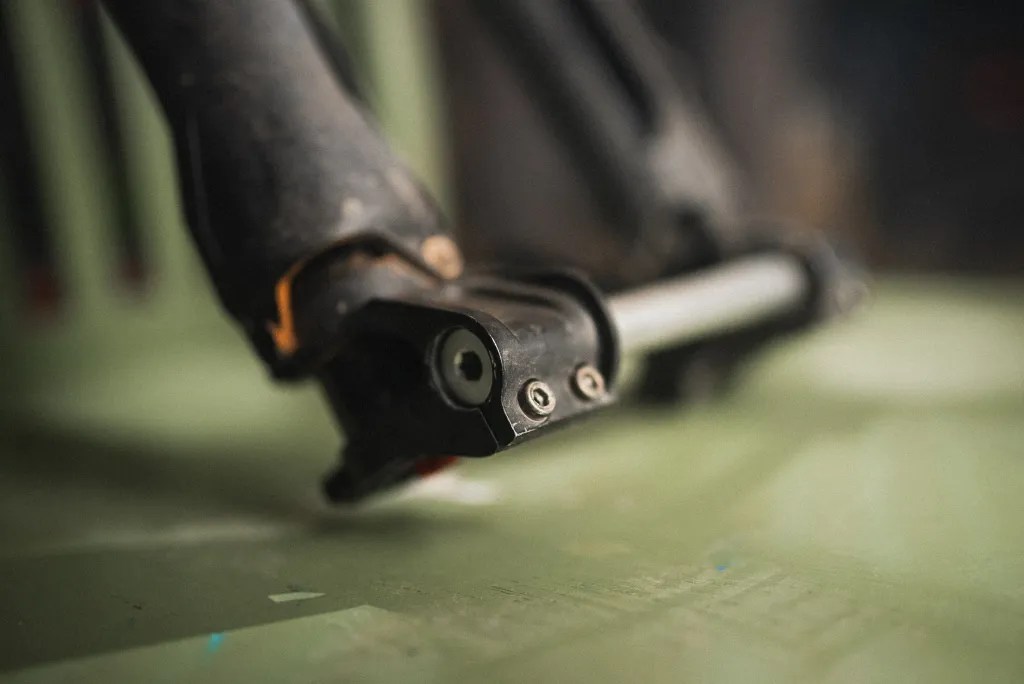
And then there’s transport. Because each leg is its own independent tube, pulling the front wheel in and out is more annoying than on a normal fork. The legs twist and can be tricky to align. If you rely on fork-mount bike racks or regularly remove your front wheel for travel, this is something you’re going to notice every single time.
The Tradeoffs with Upside-down forks
So yeah, there are tradeoffs. You get a bump in comfort, traction, and composure in rough terrain, but you pay for it with a little extra complexity and a little less convenience. Whether that’s worth it really comes down to how you ride and how much you care about those details.


Axle-to-Crown & Geometry Implications
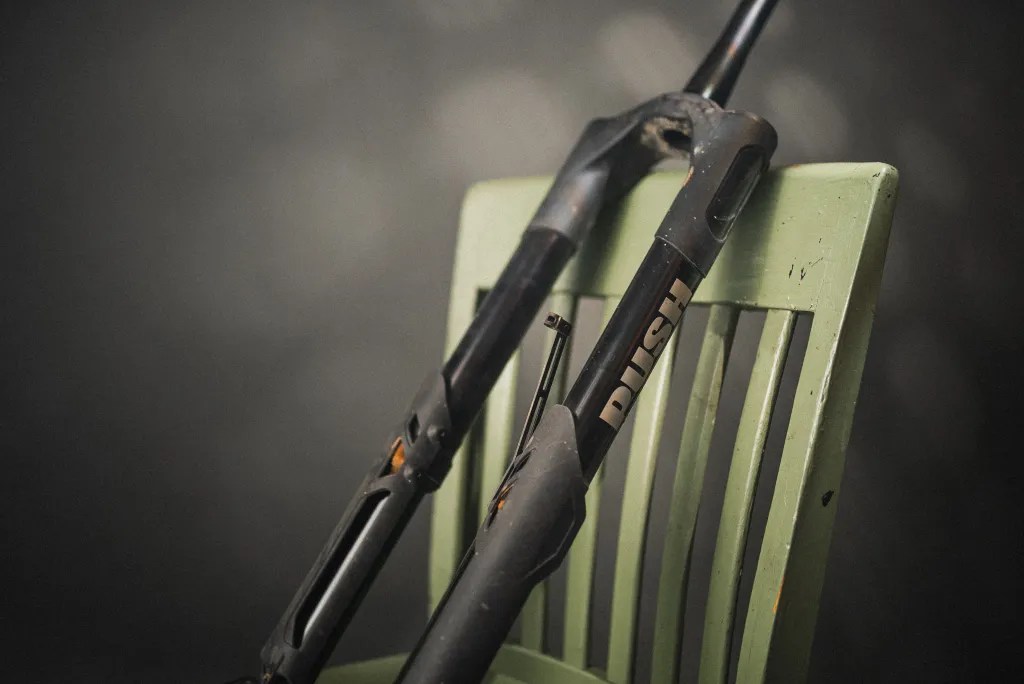
One thing I think gets overlooked with inverted forks is axle-to-crown height. For a given amount of travel, both the Podium and the Nine One are shorter than a traditional telescopic fork, mostly because you’re not dealing with a big arch.
What that means on the trail is you can run a lot of travel without automatically jacking the front end of the bike up. In this case, we swapped a 170-millimeter telescopic fork for a 170-millimeter inverted fork, and the front end actually got lower. That keeps your weight more centered over the bike instead of pushing you back. You could theoretically pack more travel into the same space. We could have run a 180mm fork and had a similar axle-to-crown measurement as stock.
That lower front end can help with front-wheel traction, especially on steep or technical terrain where a tall front end can start to feel vague or pushy. The bike feels a bit more balanced and easier to manage when you’re climbing or dropping into something steep.
And if you do want more front-end height, you still have options. Higher-rise bars, more stack under the stem, and different cockpit choices. The key difference is that with an inverted fork, you’re not forced into a taller front end just because you added travel. You get more freedom to tune the bike around how and where you ride.

Who an upside-down fork is for: Podium vs Nine One
Stepping back, inverted forks aren’t a gimmick. They ride differently, and in the right terrain, they offer real advantages. You get more comfort, better traction, and a calmer front end when things get rough. The tradeoff is added complexity and a little less day-to-day convenience compared to a traditional fork. And potentially some unwanted flex under the right conditions.
If you value outright comfort, traction, and a very composed feel in rough terrain, the Push Nine One makes a lot of sense. The coil spring and damper combination feel extremely predictable, and it rewards staying off the brakes and committing to rough lines. It’s a fork that really shines when the trail is chunky, technical, and unforgiving.
The Fox Podium, on the other hand, leans more toward speed and aggression. It still delivers the benefits of an inverted fork, but with a slightly firmer, more energetic feel. If you like pushing hard into the front end, riding fast, open terrain, and want something that feels supportive and lively at pace, the Podium fits that rider really well.
And if most of your riding is smoother, or you value simplicity, compatibility, and ease of ownership above all else, a traditional telescopic fork still makes a lot of sense. The Fox 38 remains an incredibly good benchmark for a reason.
At the end of the day, this isn’t about one fork being better than the other. It’s about choosing the right tool for the kind of riding you actually do.
That’s my take after riding both of these forks back to back and over a lot of miles. If you’ve spent time on an inverted fork, I’m curious what stood out to you long-term—ride feel, stiffness, or maintenance. Drop it in the comments.
If this was helpful, stay tuned for more showdowns. And I’ll see you next time.

Leave a Reply