


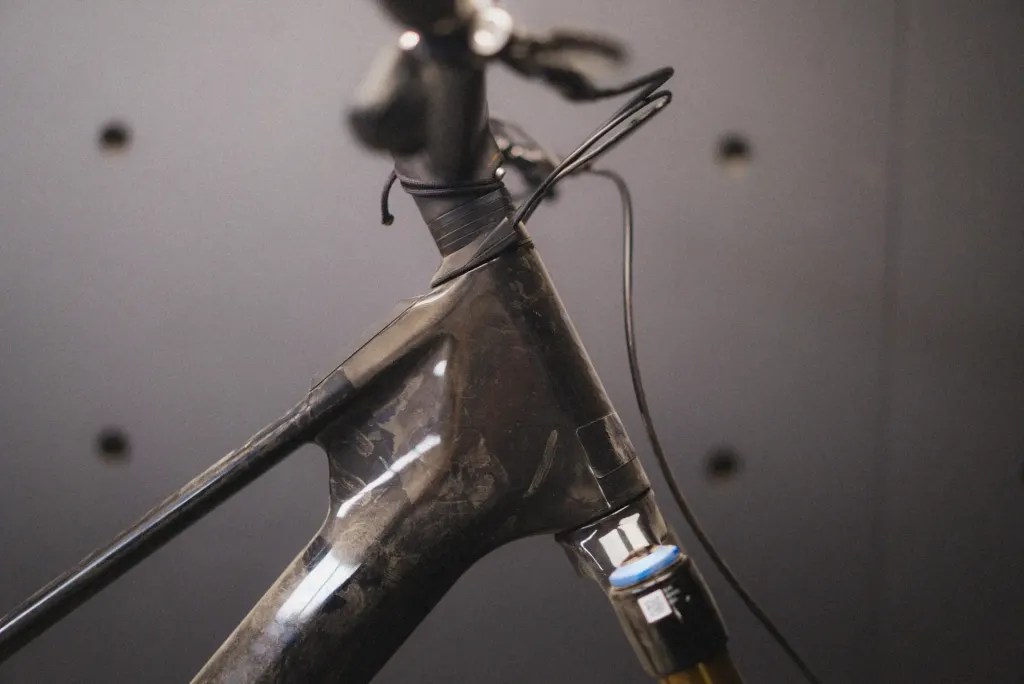
If bikes were people, the Unno Mith would be Picasso. The Mith is a work of art. The folks over at Unno clearly tapped into their Spanish art heritage when designing this thing. I’m not sure if I’ve ever seen a bike that looks this good.
Let’s cover some high-level details before we go ride. The Mith is a long-travel, full-power ebike that rolls on a mixed-wheel setup. It uses Unno’s Cero suspension design, which is a virtual pivot design. It’s designed to be run at some pretty high sag amounts. I’m sitting right above 35% on mine. And in short, it rides great.

Speaking of suspension setup brings us to one of my only gripes about this bike or, I guess, the industry as a whole. Some folks care way too much about how their damn bike looks. Don’t get me wrong; I can appreciate a good-looking bicycle, but I really don’t care. Especially if looks get in the way of performance or practicality, I feel like you’ve missed the mark. Luckily, the performance and ride quality of the Mith are well worth the tedious bike setup. Otherwise, I would have quit before I even hit the trail. I’ve never said so many cusses before. Just trying to thread on the shock pump took me two motivational David Goggins speeches, a near breakdown, and throwing eight wrenches across the garage. I’m sure my neighbors thought I was going insane. Setting up the Mith is a difficult task. Threading on the shock pump, measuring sag, adjusting damper settings, getting the integrated handlebar and stem just right, and even plugging in the charger are all finicky. I feel like looks may have gotten in the way of practicality here. I’m sure Unno has their reasons for doing things the way they did, or maybe they all have super dextrous fingers. Either way, I hated setting this thing up. Luckily, after I got on the trail, everything changed.


Unno Mith Ride Review
Climbing
I’m a big fan of the Bosch Performance CX drive system. I think it’s one of the better-performing systems out there. It offers plenty of power, good range, and doesn’t have too many bugs in my experience. The Mith compliments the Bosch’s ability well.
On the climbs, the Mith is relatively mild-mannered. The suspension is good, the geometry is well-balanced, and the handling is surprising for a big bike like this. Out of all the eMTBs I’ve ridden, this feels the most mullet to me. That small back wheel feels especially beneficial on this bike. It spins up quickly and makes that rear end feel quite a bit more agile. Considering how long the overall wheelbase is, it’s not all that difficult to get this bike around a switchback or to pick your way through some tricky sections.
The body position and balance on the Mith make it great on steep climbs. I tend to like the ebike for those stupid rides with impossible climbs and sketchy descents. The Mith fits the bill perfectly. I have a litmus test trail for ebike body position and geometry. The climb is really steep and some bikes struggle with it. The limiting factor usually is being able to keep from wheelieing too much. You often find the front wheel wandering and lifting. Also, even in your easiest gear, it can be tough to keep the pedals turning. The Mith handled this climb well. I didn’t even have to scoot uncomfortably far forward on my saddle to keep the front end down.
The Mith’s suspension design provides a good amount of traction. At 35% sag, the suspension feels rather active to me—not that I mind. That’s usually what I prefer on an ebike anyway. I’m not so concerned about efficiency when I have a motor. I’d much rather have the traction and control. I like the comfort and calmness of the more active rear on the Mith. It sticks to the ground really well, contouring most of the bumps.
The Bosch Performance Line CX motor is a good match for the Mith. It’s plenty powerful, and the range is good. Don’t plan on swapping batteries mid-ride for those mega days — the battery is integrated into the downtube. I’d really like to see a standardized race across all the motors. Say the rider gives 250 watts, and the bike is in boost. Which one is the fastest on flat ground, and which one is fastest on the really steep stuff? It’s pure conjecture, but I think the Bosch would be my overall pick. I might know a guy who could make it happen.



Descending
The overarching theme on the descents is how well that suspension performs. It’s pretty magical stuff. I recently spent a fair amount of time on the Rocky Mountain Altitude. And this feels quite a bit like that, and I’m not mad about it at all.
The Mith is designed for higher sag numbers than most bikes. I’m in the 35% range, if not a touch over that. It makes the bike hug the ground really well, contouring all the bumps and trail chatter. If you’ve ever ridden a tire insert with lower tire pressures, that’s kind of what this feels like. Except the Mith has that same effect on steroids. It plows through almost everything in its way. That does lead to a bit more difficulty bunny-hopping and getting the bike off the ground at times. Less sag would obviously help with that, but at the expense of the bump-erasing feel. Pick your poison. While the off-the-top feel is pretty soft and active, the bike doesn’t seem to wallow in the middle or run out of travel for the bigger hits. There’s plenty left in reserve for bigger impacts — and that makes sense; there’s 160mm available. I guess the part that isn’t so apparent is that even at 35-40% sag, you can still have decent mid and end-stroke support.
I like the geometry on the Mith quite a bit. For the bike’s use case, it’s very fitting — nothing seems out of place. The head tube angle is slack, as you’d expect, and the reach is long. Those two things, paired with rather long chainstays for a 27.5” rear-wheel bike, will give you a long wheelbase. The Mith is very stable both in the rough and at high speeds. I also appreciate the tall front end. As far as stack heights go, it’s up there with the tallest I’ve seen. That gives the bike a certain degree of confidence in steep terrain as well as an upright riding position. It can, on the other hand, lead to some difficulties in weighting the front wheel properly on flat terrain. I tend to ride a bike pretty far over the front, so I don’t personally have problems with it, but I can see some folks having a tougher time.
I’m not totally sure why, but the rear wheel feels extra mullet on the Mith. That back end feels very quick to get around a corner. I’m not sure I’ve ridden many bikes that scream, “I have two different sized wheels,” quite like the Mith. I don’t necessarily think that’s a bad thing, either. I can’t imagine what the handling would feel like with an even longer wheelbase of a full 29. On this bike, the MX setup works really well. With the suspension being as supple as it is, I never struggled to find traction like I’ve found on other MX bikes. I really only noticed the benefits.
There’s something special about pushing the Mith into corners with little regard for tire, bike, and human safety. It’s a good thing it comes with a Double Down rear tire because anything less wouldn’t stand a chance of staying on the rim — It’s really easy to pump into corners. I’m not sure if it’s the stability, traction, low BB, MX wheels, or what, but cornering on the Mith is really nice. It never feels squirrely, but it doesn’t feel difficult to lean over or get around a tight corner. There’s one caveat — you need a little speed. At really slow speeds, the handling gets a little sluggish.
One minor complaint about the Mith on the descents is the noise. There’s a bit of cable rattle going on with the cables in the downtube. I’m not super sensitive to that, but I know others are. I’ve also noticed that, for whatever reason, pebbles can work their way in and find themselves rattling around between the motor and the motor guard. I’m not sure if they’re sneaking in around the sides or if they’re falling in from above by the shock. Either way, I’ve had to pull the guard off to get a few out.
Unno Mith Comparisons
Mith vs Orbea Wild

It makes a ton of sense to compare this to the Orbea Wild. They both use the same motor and have similar travel lengths and geometry. They couldn’t feel more different, however. While the Mith feels plush, deep, and gooey, the Wild feels firm, sporty, and quick. Maybe the best way to describe them is by saying the Wild is the sports car, and the Mith is the trophy truck. I have to think most of the difference comes down to the suspension feel.
Mith vs Repeater Powertrain

Next up, let’s talk about the Transition Repeater. Again, we have similar travel lengths and geometry. The drive systems are different, with the Repeater using Sram Powertrain and the Mith using the Bosch. The repeater sits somewhere between the Wild and Mith for me in terms of ride quality. It’s not as plush, deep, and bottomless as the Mith, but it’s softer and more active than the Wild. It would be tough to say whether the Repeater or Mith is more capable. They both are willing to get after it when needed.
Who is the Unno Mith for?
So, who is the Mith for? I really like it for a couple of groups. The first would be the riders who love trying to peel tires off in every corner. If you love squaring off a corner and smacking it with everything you’ve got, you’ll probably really like it. For whatever reason, it’s stellar in the corners.
The Mith is also great for folks who like bottomless-feeling suspension that’s both soft off the top and supportive near the end. It’s great for folks who want to stick their heels down and plow through the rough.
Lastly, I think it’s great for the art fans. It really is like riding a piece of art. It has a very unique look that seems to stop other riders in their tracks. If you don’t like talking to other people about your bike, don’t get it. You’ll get a ton of questions out on the trail.

Well, there you have it. That’s going to wrap it up. We’ll see you next time.

Leave a Reply