


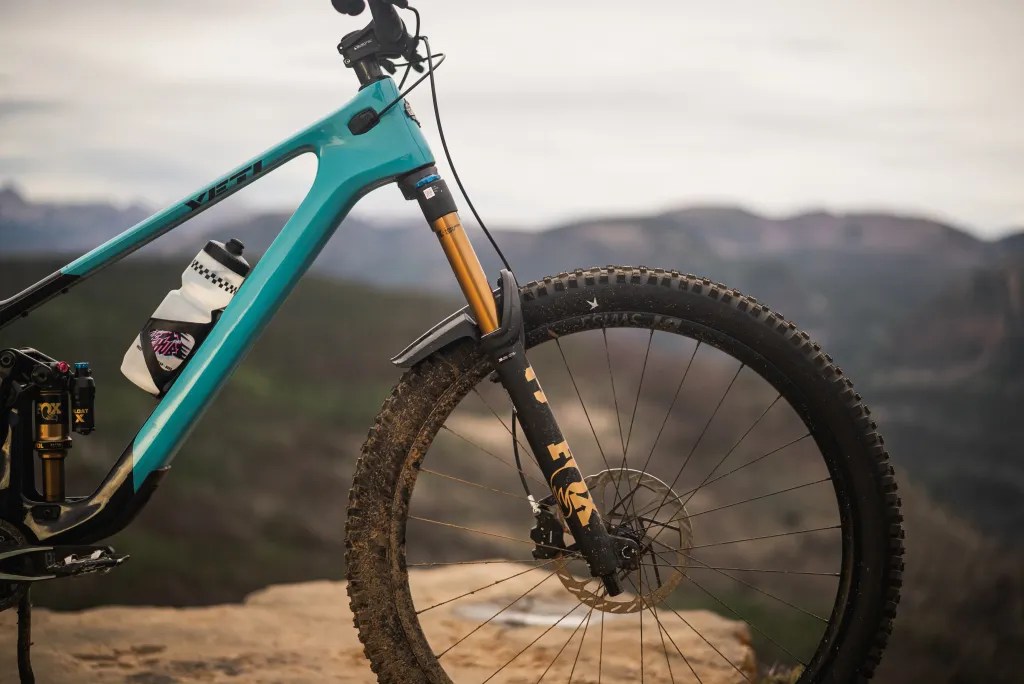
It’s not a big surprise that we are talking about this bike today – we have the Yeti MT. Yet another pedal bike with Yeti’s new design style. It comes hot on the heels of the Yeti LT, launched last month. And it looks rather similar. We get the same Sixfinity suspension platform, long rear center, and a similar design philosophy, just in a smaller, shorter-travel package.
The MT, as you may have guessed, is the mid-travel pedal bike in Yeti’s lineup. It’s the replacement for the sb130/140 category. As a quick aside, I really like Yeti’s naming convention on these new bikes. LT for long-travel, MT for mid. Put an e at the end, and now it’s the ebike equivalent of the mid- or long-travel option. Which begs the question: will we see an ST?
Yeti MT: TLDR SUMMARY
What it is.
The Yeti MT is a 140mm all-mountain bike with Sixfinity suspension, a long rear center, and a ride feel that punches well above its travel number.
Who it’s for.
Riders who want to go fast, ride rough terrain, pedal big days, and prioritize traction, stability, and control over outright pop and playfulness.
Why you should buy it
Buy the MT if you want enduro-bike confidence in a more versatile trail-bike package. It climbs efficiently, corners exceptionally well, and feels far more capable than most 140mm bikes without muting the trail.

What You Should Know About the Yeti MT
Because this bike is a big departure from what we’ve seen before from Yeti, let’s take a second to chat about some key details. The MT uses Sixfinity suspension. And god bless Yeti for designing that platform. I’ve yet to ride a Sixfinity bike that hasn’t felt magically special in the suspension department. The MT follows the trend. This bike also has long chainstays, although proportionally they aren’t as long as the LT, even if you had the shorter interchangeable dropout installed on your LT. The MT does not get the interchangeable dropout treatment. It still gets leverage-rate tuning, though via the lower shock-mount flip chip. The three positions equate to 10%, 15%, and 20% progression rates. This one only gets 29” wheels, with no flip chip to correct the geometry for swapping to MX.
I think that just about covers it. Let’s go ride.
Geometry (Size xL)
- Wheel Configuration: 29” front / 29” rear
- Rear Travel: 140mm
- Front Travel: 160mm
- Head Tube Angle: 64.5°
- Effective Seat Tube Angle: 77.0°
- Reach: 505mm
- Chainstay Length: 452mm
- Wheelbase: 1301mm
- BB Height: 342mm
- Stack: 650mm
Specs (XO)
- Frame: TURQ Series carbon fiber frame, 148mm x 12mm Boost dropouts, UDH compatibility
- MSRP: $9,800
- Frame Travel: 140mm
- Fork: Fox Factory 36 GRIP X2, 160mm
- Shock: Fox Factory Float X
- Drivetrain: SRAM X0 AXS
- Shifter: SRAM AXS Pod Controller
- Crank: SRAM X0, 30T, 165mm
- Cassette: SRAM X0, 10-52T
- Chain: SRAM X0
- Brakes: SRAM Maven Silver
- Rotors: SRAM HS2, 200mm front / 180mm rear
- Wheelset: DT Swiss XMC1700 EVO, 30mm
- Front Tire: Schwalbe Albert Trail Pro 2.5 Radial Ultra Soft
- Rear Tire: Schwalbe Romy Trail Pro 2.5 Radial Soft
- Post: Fox Transfer, 31.6mm, 210mm on LG-XL
- Bar: Yeti Carbon, 35mm clamp, 780mm width, 35mm rise
- Stem: Burgtec Enduro MK4, 35 x 50mm
- Saddle: WTB Solano Chromoly
Setup Notes
- Rider weight: 195 lbs
- Sag: 30% rear / 15% front
- Tire pressure: 29 psi front / 30 psi rear




Yeti MT: Ride Review
Climbing Performance: +1
The MT is solidly above average when it comes to climbing. Both technical and easy climbs go down quickly with the MT. It’s efficient, comfortable, and traction-y.
Starting with the suspension design, the MT features a pretty high anti-squat value. That makes it an efficient pedaling bicycle. You might be wondering, “The LT got a +2, and the MT is more efficient. Shouldn’t it get a +2?” You wouldn’t be wrong to think that, but remember these scores are relative to the category. The LT is exceptional when compared to other enduro bikes with 160mm of travel. The MT is still good but not as big of a standout performer when compared to the 140mm all-mountain bikes. In fact, I don’t think it’s materially that much better than the LT from a suspension perspective. The build, tires specifically, are probably the biggest differentiator in the climbing performance between the two.
There’s still very little pedal bob on the MT. The bike wants to get up and go. It’s very good at those long sustained efforts, as well as punchy climbs just to get up a steep pitch. It never feels like it’s dragging.
When it comes to geometry, the MT is still very comfortable and more upright than Yetis of old. In fact, the stack on the MT is the same as the LT. Of course, the LT will have a taller front end from the taller fork, but relative to the BB, the measurements are the same. Interestingly enough, though, the fit and feel aren’t identical. The MT almost feels like it has a longer seated position even though it has a shorter reach. I think it’s due to the seat tube angle being a half degree slacker than the LT. Although having less travel to sag into, both should be similar around the sag point. Part of it could also come from the longer-spec’d stem on the MT – 42.5mm (LT) vs 50mm (MT).
Compared to most bikes, the MT has a long wheelbase. But it’s proportionally shorter in the rear than the LT, so it has a shorter wheelbase with less of the wheelbase coming from the rear of the bike. That makes it easier to maneuver in certain sections, but when things get steeper, the front end will want to lift a bit more. It’s not problematic for me and hasn’t caused me to complain, but the MT does feel a bit less stable on steep and bumpy climbs than the LT. Alternatively, when you stand up on punchy steep climbs, the rear axle is now very far behind you. It can be a bit tricky to find the right body position to put power down without making the rear wheel slip out.
Downhill Capability: +2
Just like its long-legged brother, the MT tops the capability charts for its category. In fact, I rode the MT for most of a month without knowing anything about it. I purposely didn’t look at any specs or geo charts. I was pretty surprised it only had 140mm of rear travel. It wouldn’t make much sense for Yeti to make it 150mm given the overlap with the LT, but I could have sworn it rode more like a 150mm bike. It’s every bit as capable as the Santa Cruz Hightower with 10mm more travel.
The suspension plays a big part in the capability department. It keeps the bike contouring the ground precisely. It uses just the right amount of travel at any given point. That’s particularly helpful in rough terrain. If you don’t use enough travel, more of that impact will have to be absorbed by the rider. On the other hand, use too much on smaller impacts, and you might not have enough for the really big ones.
The MT’s geometry is probably taking the lion’s share of the credit here. Even though the rear center is shorter proportionally than the LT, it’s still longer than most other bikes in the category. That extra length in the back makes the bike far more stable at speed and in rough terrain. Of course, it can come with drawbacks, but the MT is not so extreme that it feels unwieldy in the handling department.
Suspension Performance: +2
It’s pretty tough not to like Sixfinity suspension. It does it all very well. It’s sensitive, supportive, and handles the big stuff. The MT has less travel than any other Sixfinity bike I’ve ridden, but it retains the best characteristics of the platform in a shorter-travel package.
Right off the top, the MT rides fairly quietly in the chatter and chunk. It contours the ground, provides traction, and keeps the bike rolling smoothly. The mid and end strokes are supportive and allow for generating speed by pumping. The MT holds momentum well, even if it’s not quite the speed demon that the LT is. I’d argue for a 140mm all-mountain bike, that’s a good thing. It keeps the bike a bit more lively and engaging to ride. There’s a bit less squish and a bit more love when you pump and bunny hop.
Handling: +1
The MT strikes such a nice balance for an all-mountain bike. It’s stable at speed, confident in the rough and steep sections, and not overly difficult to manage in slower, tighter sections. And in the corners, it’s a dream.
From a handling standpoint, the MT feels very LT-Lite. It still has that serious demeanor and need to go fast, but it’s less pronounced. The bike doesnt have a one-track mind. It’s quite a bit more versatile. That’s most apparent in the corners. The LT is good; the MT is great. The word that kept coming to mind when riding the MT was “slashy.” It’s so easy to get the bike to lean over and tear into a corner. The wheelbase is generous and offers a lot of forgiveness when you’re trying to find the center for the best traction and control. It’s hard to get the MT too bent out of shape in a corner.
Like its bigger brother, it’s not the most lively or jumpy bike. It’s significantly easier to get the MT off the ground than the LT, but it’s nowhere near the Ripmo or Fuel EX in that regard. It’s more stable and confidence-inspiring than those, even with less travel.
Versatility: +1
The MT is slightly above average in the versatility department. Yes, I know I gave the LT a +1 as well. That was primarily for setup versatility, not ride quality. The MT gets fewer setup options without the interchangeable dropouts and geometry flip chip, but it earns its +1 from its ride quality characteristics. It’s very versatile in the way it can climb and descend a huge variety of terrain. I’d happily ride everything from cruisy blues to double black diamonds on this bike. It doesnt feel like it’s too limited at either end of the difficulty spectrum.
Intangibles: 0
There’s not much to talk about here. It has the same in-frame storage design as the LT, as well as the hidden AirTag or Tile mounting location under the BB. The rest of the intangibles are pretty much to be expected from a premium brand like Yeti, so no bonus points there.

Yeti MT: Comparisons
Let’s start off with some comparisons. Today we’ll compare to the LT, as I’m sure that will be one of the most commonly asked questions. I also want to level-set against a similar bike in the MT’s category. And let’s compare to the outgoing SB140 for the folks wondering if they should upgrade.
Yeti LT vs Yeti MT

If you’ve made it this far, you will have noticed I have been comparing to the LT this entire time. The LT and MT are quite different from other bikes and extremely similar to each other. The LT obviously rides bigger, deeper, and more confidently than the MT. It has an insatiable hunger for speed and gives up a lot that doesn’t make it faster — namely handling and playfulness. The MT is similar in that it loves speed, but it loves having fun at speed. It’s not a jibby, playful bike by any means, but it’s far more engaging and active than the LT. The MT climbs better, but not by all that much. I’d imagine if you have the same tires on each bike, they’d be very similar.

Ibis Ripmo vs Yeti MT
The Ibis Ripmo is one of my favorites in the all-mountain category. It’s fun, poppy, playful, and pretty dang capable. It climbs well to boot. It’s funny how different two bikes in the same category can feel. The MT is more confident, despite having 10mm less travel. I feel much safer pushing the pace on the MT than I do on the Ripmo. And I’d have to think that comes from the wheelbase, particularly the disproportionately longer chainstays on the MT. As a result, the Ripmo’s handling is sharper and more fun. They both climb well, but I’d have to put my money on the MT if we were racing.

Yeti SB140 vs Yeti MT
Take this with a grain of salt. It’s been a minute since I’ve ridden the SB140. The outgoing SB140 felt like it had less character than the MT. It felt firmer and less supple from a suspension standpoint. It didn’t offer the MT’s ability to contour the ground perfectly. It felt a bit more traditional in terms of geometry. The MT feels more capable as a result. Where the SB140 wins in my book is the slow-speed handling category. It’s easier to steer and navigate tight sections than the longer MT. I’d have to think most West Coast riders will enjoy the MT more. It’s probably sixes for tighter, twistier East Coast-style trails.
Who is the Yeti MT for?
Rider Profile: The Ex Enduro Folks
Enduro was hot. It still is hot, but it seems that trail riding is having a bit of a resurgence as of late. The MT fills that niche nicely. It’s great for those aggressive and serious riders who no longer want or need 160mm of travel. Instead, they want something a bit more balanced and suited to general trail riding. The MT fits that bill nicely because it allows you to ride fast and aggressively with a safety net, but it doesn’t dumb down the trail as much as most enduro bikes would. I think I’m starting to find myself in this category these days. The MT is great for riding black and double black diamond terrain, but it doesn’t feel like that’s the only place it’s happy.
Rider Profile: The Trail Rider Who Lives for the Descents
Downhill is the best part of a ride. If you disagree, you’re wrong. It’s ok to be wrong. The MT is very well suited for folks who have the same mentality as me. You live for the descents but end up spending a lot of time pedaling to the top of the best ones. The MT is the bike that will get you to the top, across the weird, janky ridgeline traverse, through that other connector with that one sketchy move on it, and finally to the steep, rugged, fast, and bumpy downhill of your choice.
Rider Profile: The Wheels on the Ground Rider
I think of Zach here. If you don’t know Zach or haven’t ridden with him, he’s exceptionally talented with great bike control. He rides fast and smooth. He rarely jumps. He’s not always looking for the nastiest terrain but doesnt shy away from it. The MT would be a great bike for him. It suits the wheels on the ground, fast rider who loves knocking out big rides, even if it means there will be a lot of pedaling.
Final Thoughts
All in all, I couldn’t be happier with how Yeti designed the MT. After riding the LT, I was hoping we would see the same design philosophy in a smaller, shorter-travel package. And sure enough, Yeti came through with one hell of a bike. There’s not a lot I’d change.

Yeti LT FAQ
Is the Yeti MT a trail bike or an enduro bike?
The Yeti MT is a 140mm all-mountain or aggressive trail bike with a 160mm fork. It has much of the stability and confidence of a longer-travel enduro bike, but it climbs more efficiently and feels more versatile on everyday trail rides.
How much travel does the Yeti MT have?
The Yeti MT has 140mm of rear travel and a 160mm fork. Despite the relatively modest rear travel number, it rides more like a bigger bike in rough terrain thanks to its Sixfinity suspension and long rear center.
What is the difference between the Yeti MT and Yeti LT?
The Yeti MT is the shorter-travel, more versatile option, with 140mm of rear travel compared with 160mm on the LT. The LT is calmer, faster, and more composed in very rough terrain, while the MT is easier to maneuver, more engaging, and better suited to a wider range of trail riding.
How does the Yeti MT climb?
The Yeti MT climbs very well for a 140mm all-mountain bike. Its Sixfinity suspension has very little pedal bob, offers good traction, and feels efficient on both long sustained climbs and short, steep efforts.
Is the Yeti MT playful?
The Yeti MT is more agile and playful than the Yeti LT, but it is not a particularly jibby or poppy trail bike. It favors speed, traction, cornering, and stability over manuals, bunny hops, and constantly looking for side hits.
Who should buy the Yeti MT?
The Yeti MT makes the most sense for aggressive trail riders who want enduro-bike confidence without riding a full enduro bike. It is especially well suited to riders who pedal to demanding descents, ride black and double-black terrain, and value stability and traction more than maximum playfulness.
Leave a Reply